
Finance operations · Reference design
Invoice checks before ERP entry
Every field matched. The bank account didn't.
Let a model read invoices into candidates with page evidence, let code run the checks a careful clerk runs, and let people own every exception. Nothing becomes payable automatically.
Company Brenner is a hypothetical company. Every figure is illustrative.
About Company Brenner
Company Brenner is a hypothetical company, written for this reference design; the details below are its constraints. Every figure is illustrative, computed from stated assumptions. No client work or measured result is claimed.
- Industry
- Manufacturer of industrial enclosures and brackets
- Size
- About 450 people in two plants; five accounts-payable clerks
- Systems
- An ERP with purchase orders and goods receipts, a shared AP mailbox, a scanner for paper invoices
- Volume
- About 3,500 supplier invoices a month; month-end roughly doubles the daily load
- Controls
- Four-eyes principle; bank changes only through treasury call-back; audit wants every field traced to a page
- Constraints
- No automatic posting or payment; processing in the EU
In brief
How the work ran before
Company Brenner makes industrial enclosures and brackets, with 450 people in two plants. Its accounts payable team is five clerks. About 3,500 supplier invoices arrive every month, mostly as PDFs in a shared mailbox, some as paper that gets scanned. One in five runs to several pages. In the last three days of the month the volume roughly doubles.
A clerk opens each invoice, types the header (supplier, number, date, amounts) and the line items into the ERP, and matches them against the purchase order and the goods receipt. If something doesn't match, the clerk emails the buyer. An old OCR tool fills in some header fields, but nobody trusts it with line items.
The work is slow but careful, and the clerks are good at it. The trouble is what "careful" depends on: a person noticing.
Where it broke
Two things happen at Company Brenner in the same quarter.
First, month-end keying errors cluster on continuation pages. When a line-item table runs onto page two and the supplier's layout doesn't repeat the column headers, a tired clerk shifts a column: a quantity lands in the unit-price field. Most of these get caught by the purchase-order match. A few don't.
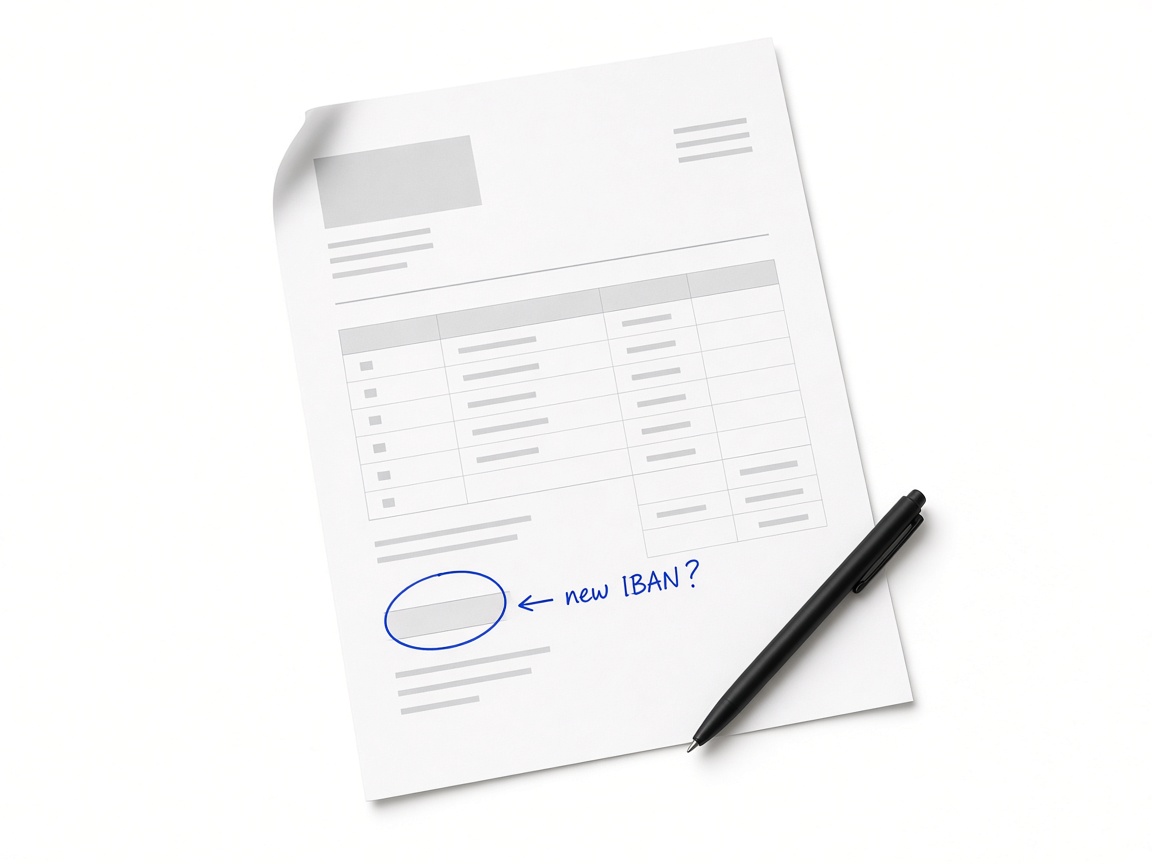
Second, and worse: an email that looks like it comes from a long-standing supplier asks to update their bank details. A week later an invoice arrives from that supplier with the new account printed at the bottom. Every other field is right: the PO number, the amounts, the tax. A treasury clerk catches it because she happens to remember the supplier's bank. It was luck, not a control.
Brenner's first instinct is "automate the typing". That is the easy half. The dangerous half is that typing and judging are done by the same person in the same motion, so any tool that takes over the typing also has to take over, or at least surface, the judging.
What I would build
I would split the work into three jobs with different owners.
- Read. A model extracts the invoice into a fixed schema: header fields, line items, totals, remittance details. Every value keeps a pointer to where it came from (page and region). These are candidates, not facts.
- Check. Plain code runs the checks a careful clerk runs: do the line items add up to the net amount, does net plus tax equal the total, does the supplier exist, is this invoice number already in the ERP for that supplier, does it match an open purchase order and goods receipt, and do the bank details match the vendor master.
- Decide. If every check passes, the system creates a parked invoice in the ERP: a draft that cannot be paid until a clerk releases it. If any check fails, the invoice goes to the queue of whoever owns that failure: AP for arithmetic and matching, procurement for unknown suppliers, treasury for bank details.
Nothing the model returns can make an invoice payable. The strongest thing the system can do is prepare a draft for a person to release.
Following one invoice through
Sample data throughout. A four-page invoice arrives as package INV-PKG-04417. The model extracts the header, 23 line items and the totals. Page 4 shows net EUR 10,487.82, tax EUR 1,992.68 and a total of EUR 12.480,50, in German number format.
The checks run in order:
| Check | Candidate value | Source | Result |
|---|---|---|---|
| Line items sum to net | 23 lines = EUR 10,487.82 | pages 1 to 3 | Pass |
| Net + tax = total | 10,487.82 + 1,992.68 = 12,480.50 | page 4, totals region | Pass |
| Supplier exists | matched on tax ID | page 1, header | Pass |
| Duplicate invoice number | none found for this supplier | ERP lookup | Pass |
| PO and goods receipt match | all 23 lines within tolerance | ERP lookup | Pass |
| Bank details match vendor master | TEST-IBAN-INVOICE-04417 vs TEST-IBAN-MASTER-009 |
page 4, remittance region | Fail |
Sample data. Both bank tokens are placeholders, not real accounts.
Five checks pass, which is exactly what makes this invoice dangerous. The system parks nothing. It routes the package to treasury with the two bank values side by side and a crop of page 4. Treasury follows its call-back procedure with the supplier's known contact. AP never sees a "ready to post" invoice for it.
Package INV-PKG-04417 · four-page invoice
Page 4 of 4 · Gross EUR 12,480.50
Candidate Not parked Bank check failedFive checks passed. The bank check has no tolerance and no override here: the package goes to treasury only.
- Line items → net
- 23 lines = EUR 10,487.82 ✓
- Net + tax = total
- 10,487.82 + 1,992.68 = 12,480.50 ✓
- Supplier · duplicate · PO and receipt
- Matched · none found · within tolerance ✓
- Remittance token (invoice)
- TEST-IBAN-INVOICE-04417 page 4 · remittance region
- Vendor-master token
- TEST-IBAN-MASTER-009 placeholder · not a real account
A quieter failure: the continuation page
A second sample, INV-PKG-CT-002, is two pages long. Page 2 continues the line-item table without repeating the header row. An extraction model can easily read "160" as the unit price instead of the quantity on that page.
| Item | Qty | Unit price | Stated total | Recomputed |
|---|---|---|---|---|
| Cable assembly | 40 | EUR 18.60 | EUR 744.00 | EUR 744.00 |
| Housing bracket | 160 | EUR 18.60 | EUR 2,976.00 | EUR 2,976.00 |
| Gasket set | 12 | EUR 31.25 | EUR 375.00 | EUR 375.00 |
Sample data. The correct reading of page 2.
Suppose the columns shift by one on page 2: the model reads 18.60 as the quantity and 2,976.00 as the unit price. The recomputed line total becomes 55,353.60, which doesn't match anything on the page, and the invoice goes to AP with the page region highlighted. The check catches the error without knowing why it happened. That is the point of doing arithmetic in code: it doesn't care which model made the mistake.
Arithmetic has a blind spot, though. If the model swaps quantity and unit price, 160 × 18.60 and 18.60 × 160 give the same total, and the line passes. That is why the purchase-order match compares unit price and quantity separately against the order. No single check is enough; they cover each other's gaps.
What changes for the team
| Task | Before | After |
|---|---|---|
| Typing headers and lines | Every invoice | Only invoices a check sends back |
| Arithmetic and PO matching | By eye, per invoice | By code, every invoice; failures explained |
| Bank-detail changes | Noticed if someone remembers | Always held for treasury |
| Audit question "where did this number come from?" | Find the PDF, search | Click through to the page region |
Illustrative planning figures, computed from assumptions stated in the technical design. Not measured.
| Illustrative month (3,500 invoices) | Manual keying | Extraction + checks |
|---|---|---|
| Invoices a clerk types in full | 3,500 | about 700 (those failing a check) |
| Invoices a clerk reviews and releases | 3,500 | 3,500 |
| Clerk time on routine invoices | about 6 min each | about 1.5 min each |
| Bank mismatches that reach "ready to pay" | depends on memory | 0, by construction |
The second row matters. Every invoice still passes through a person's hands before payment. The saving comes from turning typing into checking, not from removing the person.
What this does not solve
It cannot fix a vendor master that is already wrong: if a fraudulent bank change was entered months ago, the invoice will match it. It doesn't read contracts, so price agreements outside the purchase order are invisible to it. And an ERP's notion of a "parked" or "held" invoice differs between products; the adapter has to map onto the real permission model, not an idealized one.
How I would prove it
Take 300 invoices from last quarter that were already entered by hand, including the known problem cases. Run extraction and checks against them. Compare field by field with what the clerks entered. Report accuracy per field, and separately report every invoice where the system would have created a draft that the clerks later corrected. That second list is the one that decides whether the pilot goes ahead.
The technical design
The same system for engineers: architecture, records, failure handling, evaluation, the options I rejected, and the stack. About 5 minutes.
Keying invoices by hand?
Bring five anonymized invoices.
A few invoices, including an awkward one, plus the checks your team runs are enough to sketch the first validation workflow.