
Run folder
The complete record of one run: manifest, step folders, spans and reports.
Why. State you can open and understand without the code.
Boundary. It's local or S3 storage, not a database.
Resumable AI workflows
Run AI workflows of plain-function steps as self-contained run folders, with resume, fork, partial runs and human gates.
Prevents: A crash on item 37 forces a rerun from item 1, a changed prompt leaves stale outputs marked done, and review notes never reach the step that needs them.
Why it exists
Generative pipelines are slow, costly and partly random; scripts lose state and platforms bring servers.
Scope. A library and CLI; no server, scheduler or database.
Five-minute orientation
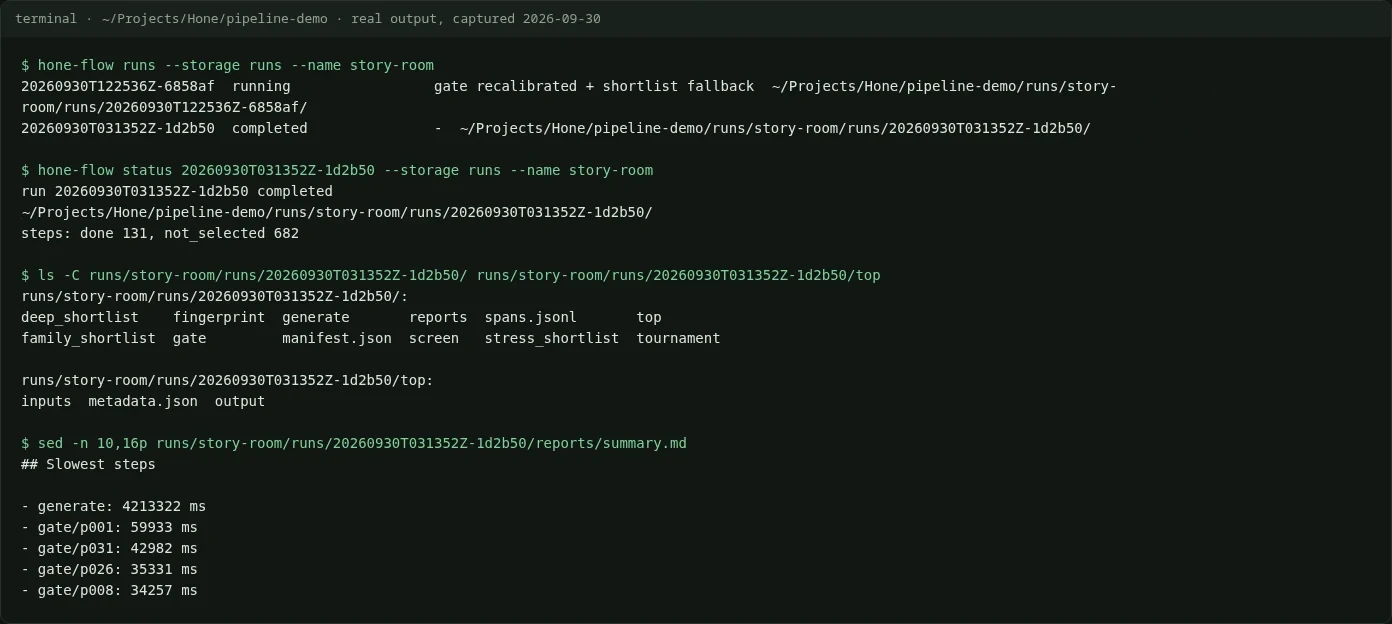
pip install "git+https://github.com/honeworks/hone-flow"Real output
Architecture
The graph comes from parameter names. Each step writes outputs first and metadata last into its own folder; the manifest and spans.jsonl sit beside them. Resume and fork read the folders; a read API opens runs without the workflow's code.
Core concepts
Operations
`hone-flow runs / status / show / approve / reject / edit / resume / fork / pin / cleanup`, each with --json.
Current boundary
Alpha. No concurrent steps, no dynamic fan-out during a run, no replay inside a step, no protection for external side effects.
Near-term roadmap. Follow the design history in design/changes/.
What it implements
Engineering checklist
Need the control, not just the component?
The repository exposes the mechanism. Production work is defining the permissions, data, failure costs, evidence, and owners around it.